What Is a Management Information System (MIS)? A Complete Guide for 2026
A deep dive into the technology, people, and processes that form the central nervous system of modern, data-driven organizations.
Imagine trying to fly a modern airplane without a cockpit. There are no gauges for speed or altitude, no radar for weather, no fuel indicators, and no navigation system. You might be able to get the plane off the ground based on instinct and what you can see out the window, but you have no real-time data to make critical decisions, manage your resources, or navigate to your destination effectively. Flying would be a chaotic, dangerous, and inefficient guessing game.
In today’s complex business world, running an organization without a Management Information System (MIS) is exactly like flying blind. An MIS is the cockpit of the modern enterprise. It’s the integrated system of technology, people, and processes that collects the torrent of raw data a business generates every second, transforms it into useful information, and presents it to managers so they can make intelligent, timely, and data-driven decisions.
This guide will serve as your complete introduction to the world of MIS. We will deconstruct the term itself, explore its fundamental purpose, analyze its core components, and see how it functions in the real world. We will also place MIS in context with other types of information systems and clarify common points of confusion. Whether you are a business student, a manager, or simply curious about the backbone of modern organizations, this guide will provide a clear and comprehensive overview.
What Is a Management Information System (MIS)? The Quick Answer
A Management Information System (MIS) is an integrated, computer-based system that gathers data from multiple business operations, processes it, and provides it to managers in the form of structured reports. Its primary purpose is to help managers at the operational, tactical, and strategic levels make more effective decisions by providing them with accurate, timely, and relevant information about the organization’s performance.
Part 1: Deconstructing the Acronym
The term “Management Information System” can sound intimidatingly technical, but it’s actually quite descriptive. Let’s break down each component to understand what it really means.
- Management: This refers to the users of the system. An MIS is not primarily for frontline employees or external customers; it is specifically designed to serve the needs of managers at all levels of an organization, from shift supervisors to C-suite executives. The information is presented in a way that supports planning, controlling, and decision-making activities.
- Information: This is the crucial distinction between an MIS and a more basic data processing system. A business generates endless streams of raw **data** (e.g., the time of a single sale, the number of units sold). An MIS takes this raw data and processes it into meaningful **information** (e.g., “a report showing the best-selling product in the Northeast region during the last quarter”). Information is data that has been organized and given context, making it useful.
- System: This refers to the fact that an MIS is not just a single piece of software. It is an integrated set of components that work together to achieve the goal. This includes the hardware, software, databases, procedures, and—most importantly—the people who operate and use it.
Part 2: The Core Purpose of MIS in Business
Why do companies invest millions of dollars in developing and maintaining these complex systems? The purpose of MIS in business is not just to collect data, but to turn that data into a strategic asset. The system serves several key functions.
1. Data Collection and Storage
An MIS acts as a central repository for the vast amounts of data generated by an organization’s various departments. It captures data from Transaction Processing Systems (TPS), which record the daily, routine activities of a business. This includes sales data from the point-of-sale system, production data from the factory floor, employee data from HR, and financial data from the accounting department. This data is then organized and stored in a structured way (typically in a database or data warehouse).
2. Data Processing and Transformation
This is where the magic happens. The MIS uses various software applications to process the stored raw data. This can involve:
- Sorting: Arranging data in a specific order (e.g., listing sales transactions by date).
- Aggregating: Summarizing data (e.g., calculating the total monthly sales for each product).
- Calculating: Performing mathematical operations (e.g., calculating the profit margin on each sale).
3. Information Reporting and Presentation
The processed information is then presented to managers in a useful format. MIS are known for their ability to generate routine, structured reports. These aren’t typically one-off analyses but are regular reports that managers use to monitor performance. Examples include:
- Weekly sales reports by region and salesperson.
- Monthly inventory level reports.
- Quarterly financial summaries.
- Daily production exception reports.
4. Supporting Decision Making
This is the ultimate goal. By providing managers with regular, accurate, and easy-to-understand reports on the performance of the business, the MIS empowers them to make better decisions. A sales manager can see which of their team members is underperforming. A production manager can spot a quality control issue on the factory floor. An executive can compare the profitability of different product lines. The fundamental role of MIS in decision making is to replace guesswork and intuition with hard data.
Part 3: The 5 Components of a Modern MIS
As we mentioned, an MIS is a complete system. It’s composed of five interdependent components that must work in harmony.
- Hardware: This is the physical technology used to run the system. It includes the computers on managers’ desks, the servers that store the data, the networking equipment (routers, cables) that connects everything, and the input/output devices like keyboards and printers.
- Software: This includes the programs that run on the hardware. It can be divided into two types:
- System Software: The operating system (like Windows Server or Linux) that manages the hardware resources.
- Application Software: The programs that perform the specific tasks of the MIS, such as the database management system (e.g., SQL Server, Oracle), the spreadsheet programs, and the specialized reporting applications.
- Data: This is the lifeblood of the MIS. The data must be accurate, timely, and secure. This component includes not just the data itself, but the Database Management System (DBMS) that is used to organize, store, and retrieve it efficiently.
- Processes: These are the rules, procedures, and business logic that govern how the system operates. This includes instructions for how to collect data, the formulas used for calculations, and the rules for who gets access to which reports. These procedures ensure the MIS runs consistently and correctly.
- People: This is arguably the most important component. An MIS is useless without skilled people to operate and use it. This includes the IT professionals who manage the system (database administrators, network engineers) and, most importantly, the end-users—the managers who use the information to make decisions.

The Definitive Textbook on MIS
“Management Information Systems: Managing the Digital Firm” by Laudon & Laudon is the gold standard academic textbook on this subject, used in university business programs around the world. For students or professionals who want a truly comprehensive, in-depth understanding of every aspect of MIS—from the technical infrastructure to the strategic business applications—this is the authoritative resource.
View on AmazonPart 4: The Broader Landscape – Other Types of Information Systems
An MIS does not operate in a vacuum. It is part of an ecosystem of different information systems within a company, each with a specific purpose. Understanding these other systems helps clarify the unique role of an MIS. For a full breakdown, you can explore our guide on the types of information systems.
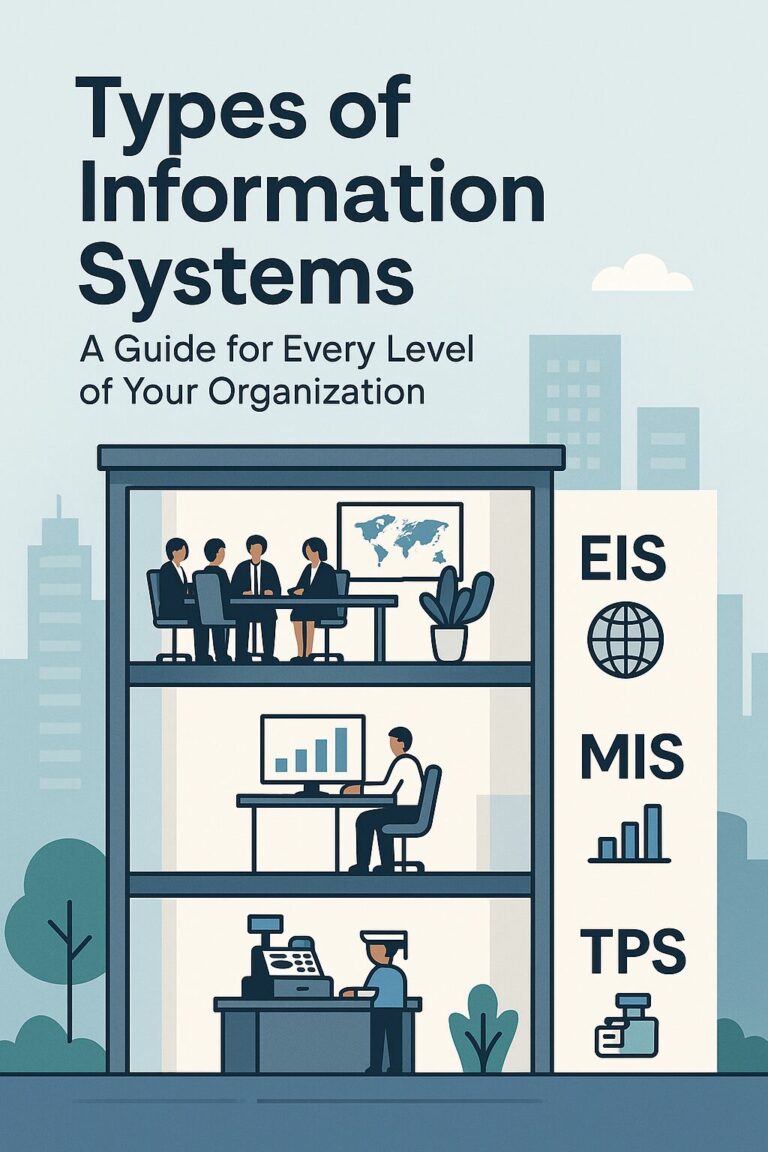
- Transaction Processing Systems (TPS): These are the systems at the base of the pyramid. They capture and process the day-to-day transactional data of the firm. Examples include a point-of-sale (POS) system in a retail store, an order entry system, or a payroll system. The TPS is a primary source of raw data for the MIS.
- Decision Support Systems (DSS): While an MIS provides structured, routine reports, a DSS is designed for more complex, non-routine decision-making. It allows a manager to interactively analyze data, use analytical models, and explore “what-if” scenarios. We’ll explore this in more detail next.
- Executive Information Systems (EIS) or Executive Support Systems (ESS): These are specialized systems designed for senior executives. They provide a high-level, graphical overview (a “digital dashboard”) of the entire organization’s performance, pulling summarized data from the MIS and DSS.
Part 5: A Critical Distinction – MIS vs. DSS
One of the most common points of confusion is the difference between a Management Information System (MIS) and a Decision Support System (DSS). While both help managers make decisions, they do so in fundamentally different ways.
An MIS helps managers understand *what is happening* (or what has happened). A DSS helps managers figure out *why it is happening* and *what would happen if* they made a certain decision.
The difference between MIS and DSS can be summarized by looking at their key attributes:
| Feature | Management Information System (MIS) | Decision Support System (DSS) |
|---|---|---|
| Primary Purpose | Monitoring and controlling organizational performance through structured reports. | Supporting complex, non-routine decision-making through interactive analysis. |
| Users | Lower to middle-level managers with routine decision-making needs. | Middle to senior-level managers and business analysts with complex problems. |
| Input | Large volumes of internal data from Transaction Processing Systems. | Data from the MIS, plus external data sources and analytical models. |
| Output | Scheduled, fixed-format reports (e.g., weekly sales report). | Interactive dashboards, simulations, “what-if” analysis, forecasts. |
| Focus | Past and present performance. Data-centric. | Future-oriented (“what-if?”). Model-centric. |
| Example Question Answered | “What were the sales figures for each region last quarter?” | “What would be the impact on our profits if we increased our marketing budget in the West region by 15%?” |
In essence, an MIS provides the standard reports, and a DSS provides the tools to dig deeper into the data from those reports to answer more complex questions.
Conclusion: The Backbone of the Modern Enterprise
A Management Information System is far more than just IT hardware and software. It is a strategic business asset that enables an organization to harness the power of its own data. By systematically collecting, processing, and delivering information, an MIS replaces intuition with insight, and guesswork with informed judgment. It is the fundamental system that allows managers at every level to monitor the health of the business, control its operations, and make the strategic decisions necessary to compete and thrive in a data-driven world. The next time you see a manager looking at a sales dashboard or a quarterly report, you’ll know you’re seeing the output of the organization’s central nervous system: its MIS.
Frequently Asked Questions About MIS
What is a simple example of an MIS?
A university’s student information system is a classic example. It collects data on student enrollment, course registration, grades, and tuition payments (from the TPS). It then generates reports for administrators, such as class enrollment summaries for department heads, lists of students on academic probation for deans, and overall revenue reports for the bursar’s office.
What is the main objective of an MIS?
The main objective of an MIS is to provide the right information to the right people (managers) at the right time and in the right format to support effective and efficient decision-making for planning and control functions within an organization.
Is MIS the same as IT (Information Technology)?
No. IT refers to the broader technological infrastructure of a company—the hardware, software, and networks. MIS is a specific *application* of IT that is focused on providing information for management. IT is the set of tools, while MIS is a specific system built with those tools to achieve a business goal.
What is a career in MIS like?
A career in MIS is often a hybrid role that bridges the gap between business and technology. Professionals with MIS degrees often work as business analysts, systems analysts, IT consultants, or database administrators. They need strong technical skills but also a deep understanding of business processes to be effective.