Network Marketing vs. Traditional Marketing: A Complete Breakdown
An in-depth analysis of two fundamentally different business philosophies, comparing their strategies, costs, risks, and roles for both companies and individuals.
Every company with a product to sell faces the same fundamental challenge: how do we get this product from our warehouse into the hands of a customer? The answer to this question defines a company’s entire business model. For decades, the dominant answer has been “traditional marketing”—a complex system of advertising, retail channels, and salaried employees. But another model has persisted and grown, one that bypasses retail stores and traditional ads entirely: network marketing.
At a glance, they might seem to be in the same business, but in reality, they operate in different universes. Traditional marketing is a top-down, company-centric model. Network marketing is a bottom-up, people-centric model. One relies on massive budgets and media buys; the other relies on personal relationships and leveraged effort. Understanding the differences is crucial not only for business owners choosing a strategy but for anyone considering a career in either field.
This guide will provide a comprehensive, side-by-side comparison. We will deconstruct each model across key business functions—from product distribution and promotion to the financial risks and daily life of the people working within them. Our goal is to give you a clear, strategic understanding of the fundamental trade-offs each model presents.
At a Glance: Key Differences
Before our deep dive, here is a high-level summary of the core distinctions between the two models.
| Feature | Traditional Marketing | Network Marketing |
|---|---|---|
| Core Strategy | Build brand awareness through mass media and sell through established retail channels. | Build a network of independent distributors to sell directly to consumers through word-of-mouth. |
| Primary Cost | High fixed costs: advertising spend, employee salaries, retail overhead. | High variable costs: commissions are paid out only when a sale is made. |
| Distribution | Manufacturer → Wholesaler → Retailer → Customer. | Company → Independent Distributor → Customer. |
| Sales Force | Salaried employees (e.g., sales reps, marketing managers). | Independent contractors paid 100% on commission. |
| Individual Risk | Low (for the employee; they have a stable salary). | High (for the distributor; income is not guaranteed, risk of financial loss). |
Part 1: Defining the Battleground
To compare the two, we must first have a clear definition of what each one is.
What is Traditional Marketing?
Traditional marketing is the set of activities that most of us think of when we hear the word “marketing.” It’s the model taught in university textbooks, built around the classic “Four Ps”:
- Product: Creating a product that satisfies a consumer need.
- Price: Setting a price for that product.
- Place (Distribution): Getting the product onto the shelves of stores where customers shop (e.g., Walmart, Best Buy, local grocery stores).
- Promotion: Making the public aware of the product through advertising (TV commercials, magazine ads, Google Ads), public relations, and other promotional activities.
What is Network Marketing?
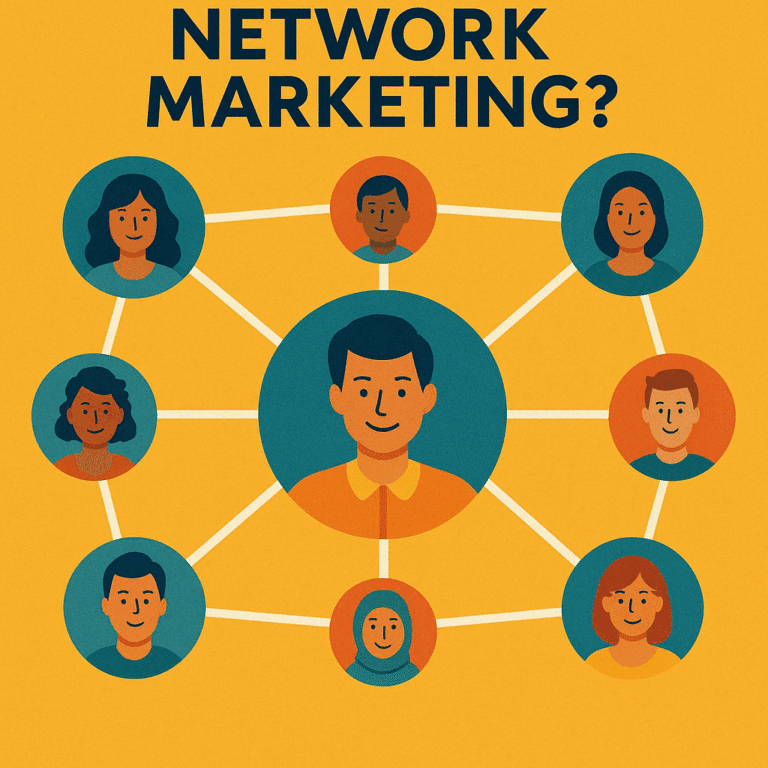
Network marketing, as we’ve detailed in our guide what is network marketing, flips this model on its head. Instead of the “Four Ps,” its focus is almost entirely on people.
- The **”Place”** is not a store; it’s a person’s home or social media feed.
- The **”Promotion”** is not a TV ad; it’s a personal recommendation from a friend or trusted acquaintance.
- The company offloads the cost and risk of marketing and sales to its network of independent distributors, paying them only when a sale is successfully made.
Part 2: The Core Strategic Differences
The philosophical differences between the models lead to vastly different operational strategies.
Strategy 1: Distribution & Reaching the Customer
In traditional marketing, securing distribution is a massive undertaking. A company like Procter & Gamble has an entire division of salaried sales representatives whose job is to negotiate with massive retailers like Walmart and Target to get their products (like Tide detergent) onto thousands of store shelves. This involves complex logistics, warehousing, and “slotting fees” (money paid to the retailer just for shelf space). The goal is to be everywhere the customer might be.
In network marketing, distribution is decentralized. The company’s main logistical challenge is shipping products directly to its thousands of independent distributors. The distributors are then responsible for the “last mile” of getting that product into the customer’s hands. The goal is not to be in every store, but to be in every social network.
Strategy 2: Promotion & Building Awareness
A traditionally marketed brand like Nike spends billions of dollars a year on advertising. They create Super Bowl commercials, sponsor celebrity athletes, and run massive digital ad campaigns. They are buying your attention through mass media. Their goal is to build a powerful brand image that you recognize and trust when you see their product in a store.
A network marketing company like Herbalife or Scentsy spends very little on traditional advertising. Their marketing budget is almost entirely allocated to paying commissions. Their brand awareness is built one conversation at a time by their distributors. They are earning your attention through a personal relationship. The history of network marketing is a story of companies that chose to invest in people instead of media.

Essential Reading: The Core of Marketing Strategy
“Positioning: The Battle for Your Mind” by Al Ries and Jack Trout is arguably the most important marketing book ever written. It introduces the revolutionary concept that marketing is not a battle of products, but a battle of perceptions in the customer’s mind. This core principle is essential for understanding both models. Traditional marketing tries to position its brand in your mind through media, while network marketing tries to position its brand in your mind through a trusted person.
View on AmazonPart 3: A Tale of Two Marketers – Roles & Responsibilities
To truly understand the difference, let’s compare the daily lives of two people working to sell a similar product—a new energy drink—one in each system.
“Corporate Marketer Mark”
Mark is a Brand Manager at a large beverage company. He is a salaried employee with benefits. His job is to manage the marketing strategy for the new energy drink. His daily tasks include:
- Analyzing market research and sales data.
- Meeting with the advertising agency to review new TV commercials and digital ad campaigns.
- Managing a multi-million dollar marketing budget.
- Collaborating with the sales team to create promotional materials for retailers.
- Presenting performance reports to senior management.
“Network Marketer Nancy”
Nancy is an independent distributor for a network marketing company that sells a similar energy drink. She is an independent contractor, paid only on commission. Her daily tasks include:
- Prospecting for new customers by talking to friends, family, and social media contacts.
- Sharing her personal testimonial about the product and posting about it online.
- Hosting sampling “parties” or doing one-on-one presentations.
- Recruiting and training new distributors for her team.
- Attending weekly team training calls and company events.
Part 4: The Financial Equation – Costs, Risks, and Rewards
The financial structures of the two models are mirror images of each other.
For the Company
A traditional company has **high fixed costs and high financial risk**. It must spend millions on advertising and salaries *before* it sells a single product, hoping to recoup the investment through sales. If the product fails, the company loses that entire investment.
A network marketing company has **low fixed costs and low financial risk**. Its marketing costs are almost entirely variable. It only pays commissions *after* a sale has been made. If a product fails, the company hasn’t lost a massive advertising budget. The financial risk is largely borne by the distributors who may have purchased unsold inventory.
For the Individual
For Mark, the corporate employee, the **risk is low**. He receives a steady paycheck and benefits regardless of whether the new energy drink is a hit or a flop. His potential reward is also capped (a salary, a potential bonus).
For Nancy, the independent distributor, the **risk is high**. She has no guaranteed income. She invests her own time and money with the possibility of earning nothing or even losing money. However, her potential reward is theoretically uncapped. If she builds a massive and productive organization, her income could far exceed a corporate salary. The different compensation plans, explained in our guide to the types of network marketing, create different risk/reward profiles.
Conclusion: Two Different Paths to the Same Goal
Neither network marketing nor traditional marketing is inherently superior. They are simply two different strategic answers to the same fundamental question. Traditional marketing is a strategy of capital and systems, while network marketing is a strategy of people and relationships. The one a company chooses depends on its product, its startup capital, and its core philosophy.
For the individual, the choice between pursuing a career in traditional marketing or joining a network marketing opportunity is a choice between security and risk, between being an employee and being an entrepreneur. Understanding the deep, structural differences we’ve outlined in this guide is the first and most critical step in determining which path aligns with your own personal and professional goals.
Frequently Asked Questions
Is one model “better” than the other?
No. They are different tools for different jobs. Traditional marketing is highly effective for mass-market products that benefit from brand recognition and wide retail availability. Network marketing can be effective for products that require a personal story, demonstration, or high-touch sales process.
Can a company use both traditional and network marketing?
Yes, this is known as a hybrid model. Some companies use traditional advertising to build general brand awareness, which then supports their network of direct sellers. For example, a company might run TV ads that direct customers to their website, where they can then be connected with a local distributor. However, it can be a difficult balance to maintain.
Why do network marketing products seem more expensive?
Network marketing products often have higher price points than comparable retail products because the price must be high enough to cover both the cost of goods and the multiple levels of commissions paid out to the distributor network. The “marketing” budget that a traditional company would spend on ads is instead built into the product’s price to fund commissions.
Is affiliate marketing considered traditional or network marketing?
Online affiliate marketing is a fascinating hybrid. It’s a form of single-tier network marketing, as it uses a network of independent people. However, it’s often used by traditional companies (like Amazon, Target, and Nike) as part of their broader digital marketing strategy. It blends the performance-based payout of network marketing with the brand-centric approach of traditional marketing.