The 6 Types of Information Systems: A Manager’s Guide
From the factory floor to the executive boardroom, a deep dive into the different information systems that form the digital backbone of a modern organization.
Think of a large, complex organization as a living organism. Just like a human body, it has different systems that perform specialized functions, all working together. You have a circulatory system to move resources, a nervous system for communication, and a skeletal system for structure. A business is no different. It has a financial system, a production system, and a human resources system. And connecting them all, acting as the digital nervous system, is a complex ecosystem of Information Systems (IS).
A common mistake is to think of a company’s “IT system” as one giant, monolithic thing. In reality, it’s a collection of several distinct types of information systems, each designed to serve a specific purpose and a specific group of users within the organization. The system that a cashier uses to process a sale is fundamentally different from the one a CEO uses to view the company’s global performance.
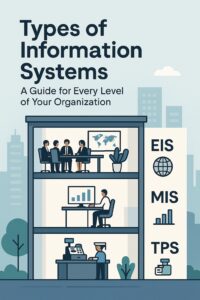
This guide will serve as your field manual to this ecosystem. We will explore the six primary types of information systems, structuring our journey based on the classic organizational pyramid—from the operational systems that handle daily transactions at the base to the strategic systems that guide executive decisions at the peak. Understanding this hierarchy is the key to understanding how a modern business truly functions.
The Information Systems Pyramid: A Quick Summary
Information systems are often categorized by the level of the organization they serve:
- Strategic Level (Executives): Served by Executive Information Systems (EIS) for high-level, long-term decision making.
- Managerial Level (Middle Managers): Served by Management Information Systems (MIS) for routine reporting and Decision Support Systems (DSS) for non-routine analysis.
- Operational Level (Frontline Staff): Served by Transaction Processing Systems (TPS) to handle the daily, routine activities of the business.
- Cross-Functional Systems: Systems like Enterprise Resource Planning (ERP) and Customer Relationship Management (CRM) integrate across all levels.
Level 1Operational-Level Systems
This is the foundation of the pyramid. Operational-level systems support the frontline managers and workers who handle the day-to-day, routine activities of the business. The goal here is efficiency, accuracy, and the processing of high volumes of transactions.
Type 1: Transaction Processing Systems (TPS)
If an information system were an iceberg, the TPS would be the massive, unseen portion below the waterline. It is the most fundamental type of information system, and its primary purpose is to answer the routine question: “What is happening right now?”
Purpose: To capture, process, and record the daily transactional data necessary to run the business. A TPS records an event, whereas other systems report on and analyze those events.
Users: Operational staff (e.g., cashiers, warehouse workers, bank tellers, order entry clerks) and their immediate supervisors.
Key Characteristics:
- High Volume: They process thousands or even millions of transactions per day.
- High Speed: They must process these transactions in real-time or near-real-time to keep the business running smoothly.
- High Accuracy and Reliability: The data captured by a TPS must be perfect, as it is the source data for all other information systems in the company. An error here will cascade up the pyramid.
Real-World Examples:
- Point-of-Sale (POS) System: When you buy groceries, the cashier scans your items. The POS system records the sale, updates the inventory, and processes your payment. This is a classic TPS.
- Airline Reservation System: When you book a flight, the system processes your booking, assigns you a seat, and handles the payment. – Payroll System: This system processes employee hours, calculates pay and deductions, and generates paychecks.
- Order Processing System: An Amazon warehouse worker scans a product to fulfill an order. The system updates the order status and inventory levels.
Think of the TPS as the data-gathering workhorse of the organization. It doesn’t provide deep insights, but without the accurate data it collects, no insights would be possible.
Level 2Managerial-Level Systems (Tactical)
This middle layer serves the needs of middle managers (e.g., regional sales managers, plant managers, department heads). Their focus is on monitoring and controlling the activities of the operational level and making short-to-medium-term decisions. The information they need is more summarized and analytical than raw transactional data.
Type 2: Management Information Systems (MIS)
The MIS is the classic information system that most people think of. It takes the raw data from the various TPS across the organization and transforms it into structured, summary reports for managers.
Purpose: To provide managers with routine reports and summaries of the organization’s performance. The primary purpose of MIS in business is to support routine decision-making, planning, and control.
Users: Middle managers.
How it Works: An MIS pulls data from multiple TPS. For example, it might take sales data from the POS system and cost data from the accounting system. It then processes this data to generate reports like a “Quarterly Sales Report by Product Line,” showing total sales, costs, and profit margins for each product. For a full breakdown, see our guide on what is a management information system.
Real-World Example: The manager of a university’s admissions office uses an MIS. The underlying TPS collects every single application. The MIS aggregates this data to produce a weekly report showing the number of applications received by state, by major, and compared to the same week last year. This allows the manager to monitor the progress of the admissions cycle and make tactical decisions, like allocating more resources to follow up with applicants from a specific state.
Type 3: Decision Support Systems (DSS)
While an MIS is excellent for routine questions (“How did we do last quarter?”), managers also face non-routine problems that require more sophisticated analysis (“What would happen if we changed our pricing?”). This is where a DSS comes in.
Purpose: To provide managers with tools to analyze data and make semi-structured or unstructured decisions. A DSS is interactive and allows for “what-if” analysis.
Users: Middle managers, business analysts, and knowledge workers.
How it Works: A DSS uses data from the TPS and MIS, but it also incorporates external data (e.g., market trends, competitor prices) and complex analytical models. A manager can use a DSS to simulate the effects of a decision. For a detailed comparison, see our guide on the difference between MIS and DSS.
Real-World Example: A logistics manager for a shipping company needs to decide the optimal route for a new delivery truck. An MIS can give her a report on past fuel costs. A DSS, however, would allow her to input various routes, and the system would use a model incorporating variables like traffic patterns, fuel costs, and driver hours to calculate the most cost-effective route. She can interact with the system, changing variables to see how it impacts the outcome.

The Essential Textbook for Business Students
“Using MIS” by David M. Kroenke is another foundational textbook used in thousands of university classrooms. What sets it apart is its strong focus on how these systems are actually *used* by managers to solve business problems. It provides an excellent, in-depth exploration of all the system types discussed here with a practical, case-study-based approach.
View on AmazonLevel 3Strategic-Level Systems
At the apex of the pyramid are the senior executives (CEOs, CFOs, VPs). Their focus is not on daily operations or monthly reports, but on the long-term, strategic direction of the entire organization. The decisions they make are unstructured and high-stakes.
Type 4: Executive Information Systems (EIS) / Executive Support Systems (ESS)
An EIS is a specialized DSS designed for the unique needs of senior executives. It’s all about the big picture.
Purpose: To provide senior executives with a high-level, easy-to-use system to monitor the overall health of the organization and support strategic decision-making.
Users: C-suite executives and senior management.
How it Works: An EIS presents summarized information from the MIS and DSS in a graphical “digital dashboard.” It features charts and graphs showing key performance indicators (KPIs) for the entire company. A key feature is the “drill-down” capability. A CEO can see a high-level chart of company sales. If she sees a dip in one region, she can click on that part of the chart to “drill down” and see the more detailed MIS reports for that region.
Real-World Example: The CEO of a multinational corporation starts her day by looking at her EIS dashboard. It shows her real-time global sales figures, the company’s current stock price, and key financial ratios. It also pulls in external data, like news headlines about her main competitors. She sees that sales in the Asia-Pacific region are down 5%. With a single click, she drills down to the regional MIS reports to see which country and product line is underperforming, prompting a strategic conversation with her VP of International Sales. The role of MIS in decision making at this level is about providing the initial signal for deeper strategic inquiry.
Cross-Functional Enterprise Systems
The pyramid model is a useful way to understand the different levels, but modern businesses are more interconnected. Enterprise systems are designed to break down the “silos” between departments and integrate information across the entire organization.
Type 5: Enterprise Resource Planning (ERP) Systems
Purpose: To integrate all of a company’s key business processes into a single, unified software system with a central database.
How it Works: Before ERP, a company might have one system for HR, another for finance, and a third for manufacturing. These systems couldn’t talk to each other. An ERP system, like SAP or Oracle, replaces these separate systems with a single integrated one. When a salesperson enters an order, the ERP system automatically updates inventory, schedules the shipment, generates an invoice, and updates the financial accounts. Everyone in the company is looking at the same real-time data.
Type 6: Customer Relationship Management (CRM) Systems
Purpose: To manage all of a company’s relationships and interactions with its customers and potential customers.
How it Works: A CRM system, like Salesforce or HubSpot, provides a central place to store customer contact information, track their interactions with the company (emails, phone calls, purchases), and manage the sales pipeline. It integrates the sales, marketing, and customer service departments, giving them a complete, 360-degree view of the customer.
Conclusion: An Integrated Ecosystem
As we’ve seen, an organization doesn’t have one “information system.” It has a diverse ecosystem of specialized systems, each playing a vital role. The Transaction Processing Systems are the hands, capturing the raw data of daily work. The MIS and DSS are the brainstem and midbrain, processing that data into coherent reports and analyses for tactical management. And the Executive Information Systems are the cerebrum, providing the high-level strategic overview for long-term direction. Together, this integrated digital nervous system is what allows a modern organization to function, adapt, and thrive in a complex world.
Frequently Asked Questions About IS Types
What are the 3 main types of information systems?
The three main logical types, corresponding to the levels of an organization, are: 1) **Operational Systems** like Transaction Processing Systems (TPS) for daily tasks, 2) **Managerial Systems** like Management Information Systems (MIS) and Decision Support Systems (DSS) for middle-management control, and 3) **Strategic Systems** like Executive Information Systems (EIS) for long-term executive planning.
Is a CRM system a type of MIS?
It’s more accurate to say that a CRM is a specialized type of enterprise system that contains many MIS-like features. A CRM’s primary function is operational (managing customer interactions, like a TPS), but it also produces a wide range of reports (e.g., sales pipeline reports, customer service response times) that are used by managers, which is a core function of an MIS.
What is the oldest type of information system?
Transaction Processing Systems (TPS) are the oldest. The earliest business computers in the 1950s and 60s were used for automating highly structured, high-volume tasks like payroll and accounting, which are classic TPS functions.
Where does Artificial Intelligence (AI) fit into these systems?
AI is being integrated into all levels of information systems. In a TPS, AI might be used for fraud detection. In a DSS, AI-powered machine learning models can be used for much more accurate forecasting. In an EIS, AI can be used to identify subtle patterns and anomalies in data that a human might miss, providing predictive insights to executives.