The 10 Deadly Forex Trading Mistakes That Will Wreck Your Account
A brutally honest look at the common errors that separate the 90% who fail from the 10% who succeed—and how to ensure you’re in the right group.
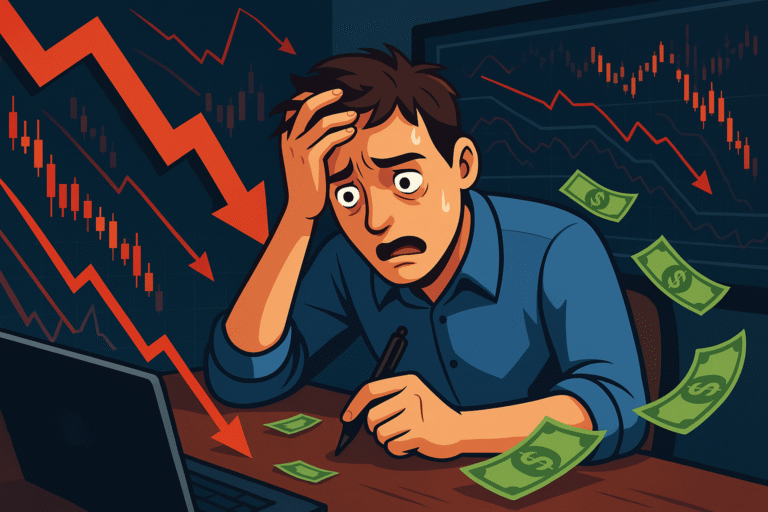
Let’s get one thing straight: every single trader, from George Soros down to the person who just opened their first account, makes mistakes. Trading is a game of probabilities, not certainties, and losses are a non-negotiable part of the business. The difference between a professional and a struggling amateur isn’t that the pro never makes mistakes. It’s that the pro has learned to avoid the *catastrophic* ones—the big, dumb, account-destroying errors that are born from emotion, ego, and a lack of discipline.
This isn’t just another list. This is a deep dive into the psychology behind the most common forex trading blunders. We’re going to explore *why* traders make these mistakes and provide you with a concrete, actionable “Pro Solution” for each one. Think of this as your personal coaching session on what *not* to do. Internalizing these lessons is more valuable than any “holy grail” indicator, because it addresses the root cause of failure: the trader. As you’ll learn, inexperience causes large losses precisely because it leaves a trader vulnerable to these exact psychological traps.
Quick Summary: The Top 5 Account Killers
- No Stop Loss: Turning a small, acceptable loss into a devastating one out of pure hope.
- Risking Too Much: Wagering a huge percentage of your account on a single trade, effectively playing Russian Roulette with your capital.
- Revenge Trading: Emotionally jumping back into the market after a loss to “get your money back,” which almost always leads to bigger losses.
- Overleveraging: Using the broker’s “loan” to take positions that are far too large for your account size, making you extremely vulnerable to small market moves.
- No Trading Plan: Clicking buy and sell based on gut feelings and emotions instead of a pre-defined, logical set of rules.
Mistake #1: Trading Without a Stop Loss
This is, without a doubt, the cardinal sin of trading. A stop-loss order is a pre-set instruction you give your broker to automatically close your trade at a specific price point. It is your ultimate safety net.
Why It’s So Dangerous
The psychology here is simple but deadly: **hope**. A trader enters a position, and it immediately goes against them. Their pre-planned exit point is hit, but they think, “It’ll turn around.” They cancel their stop loss, convinced the market will prove them right. Hope is a wonderful human emotion, but in the trading world, it is the single most expensive feeling you can have. Trading without a stop loss is not a strategy; it is the act of giving the market a blank check drawn from your account.
A Real-World Example
Trader Tom buys EUR/USD at 1.0800, convinced it’s going to the moon. He thinks a stop loss at 1.0750 is for nervous amateurs. The price drops to 1.0750. “Just a small dip,” he thinks. It drops to 1.0700. “Okay, this is the bottom, it has to bounce now.” It drops to 1.0600. Now his small paper cut of a loss has become a gaping wound, and he’s paralyzed by fear. He finally capitulates and sells, taking a loss ten times larger than he ever should have.
The Pro Solution: The “Set It and Forget It” Rule
Your stop loss is your line in the sand. It is your admission that you might be wrong about a trade, and it defines the exact price you’re willing to pay for that mistake. **The moment you enter a trade, you must place your stop loss immediately.** Then, with very few exceptions for advanced strategies, you do not touch it. You never widen it because you “hope” the trade will turn around. A professional trader understands that their job is not to be right on every trade, but to ensure that when they’re wrong, the damage is small and controlled.
Mistake #2: Risking Too Much Per Trade
This mistake is the partner in crime to trading without a stop loss. It’s the act of betting too large a portion of your trading capital on the outcome of a single trade.
Why It’s So Dangerous
The allure of “one big score” is powerful. A new trader, perhaps with a small account, thinks, “If I just risk 20% on this ‘sure thing,’ I can double my account fast!” This turns trading into a casino game. Even with a winning strategy that is right 60% of the time, a string of just five losses in a row would wipe out their entire account. The math is brutal and unforgiving. Risking too much makes you psychologically fragile; every tick against you feels like a punch to the gut, leading to panic decisions.
A Real-World Example
Trader Jane has a $2,000 account. She sees a trade setup she loves in GBP/JPY and decides to risk $500 (25% of her account). The trade goes against her and hits her stop loss. Her account is now down to $1,500. She’s now emotionally compromised and needs to make a 33% return just to get back to even. The pressure is immense, and she’s far more likely to make another bad decision.
The Pro Solution: The 1% Rule
Professionals think in terms of longevity. They know that to make money over the long run, they first have to survive the short run. The industry standard for prudent risk management is to **never risk more than 1-2% of your trading capital on any single trade.** With the 1% rule, Jane would have only risked $20 on her trade. A loss would have been a minor annoyance, not a psychological disaster. This rule ensures you can withstand the inevitable losing streaks and stay in the game long enough for your edge to play out. For a full breakdown, you must read our guide on forex risk management basics.
Mistake #3: Overleveraging
Leverage is what makes forex attractive to so many traders with smaller accounts. It’s a tool that allows you to control a large amount of currency with a small amount of your own capital. But as Uncle Ben said, “With great power comes great responsibility.”
Why It’s So Dangerous
Brokers in the U.S. can offer up to 50:1 leverage. A new trader sees this and thinks, “Great! I can turn my $1,000 into a $50,000 position!” They don’t realize that leverage is a double-edged sword that magnifies losses just as much as it magnifies profits. When you overleverage, even a small, normal market fluctuation against you can trigger a margin call, where your broker automatically closes your position, often wiping out a huge portion of your account. It’s like driving a Ferrari in a school zone—the slightest mistake has massive consequences. Understanding how this tool works is a key part of learning how forex trading works.
The Pro Solution: Let Your Risk Define Your Position Size
Leverage should be a byproduct of your risk management, not a tool to get rich quick. Your focus should always be on the 1% rule. The amount of leverage you end up using will be determined by your position size calculation, which is based on your stop loss distance and your chosen 1% risk. Forget about the maximum leverage your broker offers. Use the minimum required to take a trade that fits your risk parameters. Pros use leverage as a tool for capital efficiency, not as a throttle for gambling.

Essential Reading: Master Your Mental Game
“Trading in the Zone” by Mark Douglas is the definitive guide to trading psychology. It doesn’t teach a single strategy but instead focuses on instilling the core beliefs and attitudes necessary for success. It directly addresses the psychological flaws behind nearly every mistake on this list. Reading this book is non-negotiable for serious traders.
View on AmazonMistake #4: Revenge Trading
This is a purely emotional mistake. You take a loss—maybe one that felt unfair or one where you were stopped out by a single pip—and you feel an intense urge to jump right back into the market to win that money back immediately.
Why It’s So Dangerous
When you’re revenge trading, the logical, analytical part of your brain has shut down. You’re operating from the primal, emotional center. Your decisions are not based on your trading plan or any valid setup; they are based on anger and frustration. You’ll likely trade a larger size, ignore your rules, and take a low-probability setup. It’s the trading equivalent of hitting a slot machine again because you “feel” it’s due for a payout. It almost always leads to a second, often larger, loss, creating a vicious downward spiral.
The Pro Solution: The Mandatory “Cool-Down” Period
If you experience a loss that leaves you feeling angry, flustered, or emotional, the professional response is to **walk away from the screen.** Institute a personal rule: “After a significant loss (or two consecutive losses), I will close my platform and take a minimum 30-minute break.” Go for a walk, listen to music, do anything to break the emotional state. The market will still be there when you get back. Your capital might not be if you give in to revenge trading.
Mistake #5: Trading Without a Plan
A trading plan is your business plan. It’s a written document that outlines exactly what you’re trying to achieve and how you’re going to do it. Trading without one is like trying to build a house without blueprints.
Why It’s So Dangerous
Without a plan, every decision is subjective and emotional. You’ll buy because you have a “good feeling.” You’ll sell because you saw a scary-looking candle. You have no way to measure your performance or identify what’s working and what isn’t. You are, in effect, just gambling. You’re a ship without a rudder, at the mercy of the market’s emotional waves.
The Pro Solution: Write It Down
Your trading plan doesn’t have to be a 100-page dissertation, but it must be written down. It should clearly define:
- Your Trading Strategy: The exact technical or fundamental conditions for entry.
- Your Risk Parameters: Your risk per trade (the 1% rule), your stop loss placement strategy.
- Your Trade Management Rules: How you will manage the trade after entry?
- Your Markets and Timeframes: What currency pairs will you trade and on what charts?
The Other Five Common Mistakes…
The five mistakes above are the primary account-killers, but these next five are just as capable of slowly bleeding your account dry and destroying your confidence.
Mistake #6: Not Demo Trading Properly
A demo account is a powerful learning tool, but most beginners use it as a video game to rack up a high score with fake money. They trade massive sizes and take huge risks they would never take with real capital. This builds terrible habits.
The Pro Solution: Treat your demo account exactly like a real account. Use the same starting capital you plan to trade with live. Follow your trading plan and your 1% risk rule on every single trade. The goal is not to make a billion fake dollars; the goal is to practice flawless execution of your plan.
Mistake #7: Adding to a Losing Position
“Averaging down” might work in long-term stock investing, but in the fast-moving, leveraged world of forex, it’s poison. This is the act of buying more of a currency pair as it continues to fall, lowering your average entry price but dramatically increasing your risk.
The Pro Solution: Never add to a loser. Period. Your initial trade thesis was wrong. Accept the small, defined loss and move on to the next opportunity. Professionals add to their *winning* positions to press their advantage, not their losing ones.
Mistake #8: Ignoring the Big Picture
Many traders get tunnel vision, staring at a 5-minute chart and ignoring the major trend on the daily or weekly chart. They try to buy in a market that is clearly in a powerful downtrend, fighting a losing battle against the market’s primary momentum.
The Pro Solution: Always start your analysis from a higher timeframe (daily, weekly) to establish the overall market context and trend. Then, zoom in to a lower timeframe to find your precise entry points. Trade with the tide, not against it.
Mistake #9: System Hopping
A trader tries a strategy for a few days. After two losses, they declare it “broken” and jump to a new “holy grail” system they found online. They repeat this cycle endlessly, never giving any single strategy enough time to play out over a large sample of trades.
The Pro Solution: Pick a sound, logical strategy and commit to trading it for at least 50-100 trades. Keep a detailed journal. Only after a statistically significant sample size can you make an informed decision about whether the strategy works for you.
Mistake #10: Unrealistic Expectations
This is the root of many other mistakes. Fueled by social media hype, beginners expect to turn $500 into $50,000 in a month. This leads them to overleverage, risk too much, and abandon sound principles in a desperate rush for profits.
The Pro Solution: Understand that trading is a profession, not a lottery. A good, consistent return for a professional trader might be 2-5% per month. It’s about slow, steady growth, not overnight riches. Adjust your expectations to reality, and you’ll make better decisions. To understand the market’s true nature, review our guide on what the forex market is.
Conclusion: The Path to Improvement
Avoiding these ten mistakes is the single most effective thing you can do to improve your trading results. Notice that none of them are about finding a better indicator or a secret chart pattern. They are all about discipline, mindset, and professional risk management. Print this list out. Review it weekly. Be brutally honest with yourself about which mistakes you are still making. By systematically eliminating these self-sabotaging behaviors, you clear the path for your trading strategy to actually work and for you to achieve the consistency you seek.
Frequently Asked Questions About Trading Mistakes
What is the single biggest mistake in forex?
While all are dangerous, the single biggest mistake is arguably **trading without a pre-defined stop loss.** It is the one error that can allow a single bad trade to wipe out your entire account, no matter how good your strategy is otherwise.
How do I stop emotional trading?
The key is to systematize your trading as much as possible through a written trading plan. When you have pre-defined rules for entry, exit, and risk, there are fewer decisions to make “in the moment,” which is when emotions take over. Taking breaks after losses is also a crucial tactic.
Is it a mistake to hold a trade over the weekend?
It’s not necessarily a mistake, but it is an advanced tactic that carries additional risk. The market can gap significantly at the open on Sunday evening due to news that broke over the weekend, potentially jumping right over your stop loss. Beginners are generally advised to trade on shorter timeframes and be flat (out of all positions) by the market close on Friday.