
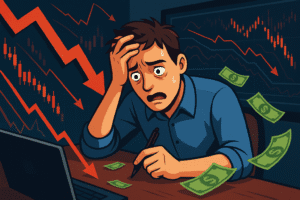
Why Do 90% of Forex Traders Fail? Unpacking the Massive Losses from Inexperience
A deep dive into the psychological traps, strategic blunders, and critical oversights that drain trading accounts—and how you can avoid them.
Key Takeaways
- Psychology is Paramount: Emotional trading, driven by greed and fear (FOMO), is the leading cause of catastrophic losses, far more than a bad strategy.
- Overleveraging Amplifies Mistakes: Leverage is a tool, not a shortcut to riches. Inexperienced traders often use excessive leverage, which turns small market movements into account-ending events.
- No Plan, No Profit: Trading without a clearly defined, written trading plan is akin to gambling. A plan must include entry/exit rules, risk management, and position sizing.
- Risk Management is Non-Negotiable: The failure to use stop-loss orders and properly size positions is the single most destructive technical mistake a new trader can make.
- Education is Your Best Investment: The market will ruthlessly take your money if you don’t first invest time in understanding how it works. Rushing into live trading without a solid educational foundation is a recipe for disaster.
The allure of the foreign exchange (forex) market is undeniable. It’s the largest, most liquid financial market in the world, with trillions of dollars changing hands every day. Advertisements promise a life of financial freedom, working just a few hours a day from a laptop on a beach. This powerful imagery draws in millions of aspiring traders from all corners of the United States, each hoping to carve out their piece of the pie. But there’s a grim reality lurking behind the hype—a statistic that brokers don’t put on their billboards: the overwhelming majority of retail forex traders lose money and quit.
Estimates vary, but it’s widely accepted that somewhere between 80% and 95% of new traders fail within their first year. This isn’t due to a rigged market or a secret algorithm held by the pros. The cause is far more straightforward and, fortunately, far more preventable: inexperience. Inexperience isn’t just about not knowing which button to click; it’s a multi-faceted problem that manifests as psychological weakness, a complete lack of strategy, and a fundamental misunderstanding of risk. This article will dissect the anatomy of these failures, exposing the seven critical mistakes that transform eager beginners into disheartened statistics.
Mistake #1: The “Get Rich Quick” Delusion
The most pervasive and dangerous mindset a new trader can have is the belief that forex is a fast track to wealth. This mentality is fueled by social media influencers flaunting rented Lamborghinis and promises of “100% winning signals.” It creates a psychological trap that prioritizes immediate, large profits over sustainable, long-term growth.
The Psychology of Unrealistic Expectations
When you expect to double your $500 account in a week, your decision-making becomes warped. You start taking trades that are far too large for your account size. A single loss, which should be a minor setback, becomes a devastating blow. This leads to “revenge trading”—an emotional, impulsive attempt to win back your losses by taking even riskier trades. It’s a vicious cycle that almost always ends with a zero balance.
“The market is a device for transferring money from the impatient to the patient.” – Warren Buffett
While Buffett’s quote is about stocks, it’s doubly true for forex. Professional traders think in terms of percentages and probabilities over a large series of trades. They aim for consistent, modest gains. An inexperienced trader, blinded by greed, is focused on the dollar amount of a single “home run” trade.
The Solution: A Paradigm Shift to Process Over Profits
You must shift your focus from making money to making good decisions. Your primary goal as a new trader isn’t to get rich; it’s to survive and learn. Celebrate a well-executed trade that followed your plan, even if it resulted in a small loss. Scrutinize a trade that made money but broke all your rules. This mental shift is the first and most crucial step toward longevity in the markets. A deep understanding of trading psychology is essential, and it’s where most traders should begin their education.

Essential Reading: Master Your Mindset
“Trading in the Zone” by Mark Douglas is considered the bible of trading psychology. It provides a clear framework for developing the mental discipline required to think in probabilities and execute a trading plan without emotional interference. This book is a must-read before you risk a single dollar.
View on AmazonMistake #2: Ignoring the Steep Educational Curve
You wouldn’t try to perform surgery after watching a few YouTube videos, yet thousands of people try to trade the world’s most competitive market with less preparation. They might read a short article or two, open a brokerage account, and start clicking “buy” or “sell.” This is the financial equivalent of jumping into the deep end of the ocean without knowing how to swim.
What You Don’t Know WILL Hurt You
The forex market has its own language and mechanics. Inexperienced traders often lack a basic understanding of critical concepts:
- Pips and Lots: They don’t understand how price movements (pips) translate into profit or loss based on their position size (lots).
- Margin and Leverage: They see leverage only as a way to make more money, failing to grasp that it also magnifies losses and can lead to a “margin call,” where the broker forcibly closes their positions.
- Market-Moving Events: They are unaware of how major economic news releases, like the U.S. Non-Farm Payrolls report, can cause extreme volatility and wipe out an unprepared trader.
- Currency Correlations: They might simultaneously buy two currency pairs that typically move in opposite directions (e.g., EUR/USD and USD/CHF), effectively canceling each other out while paying the spread on both.
A solid foundation is not optional. Before you can develop a strategy, you must first understand the environment you’re operating in. This begins with learning what the forex market is and the fundamental principles of how it functions.
The Solution: Become a Perpetual Student of the Market
Commit to a structured learning path. Treat it like a university course. Your curriculum should start with the absolute basics and progressively move to more complex topics. A great starting point is a comprehensive guide to forex trading for beginners, which lays out all the core concepts in an organized manner.
- Start with a Demo Account: Every reputable broker offers a free demo account with virtual money. Spend at least 3-6 months trading on a demo account. The goal isn’t to make fake money; it’s to test your strategies, learn the trading platform, and experience the emotional swings of winning and losing without real financial consequence.
- Read Voraciously: Absorb high-quality information from books, reputable financial websites, and broker educational resources.
- Focus on One Pair: Don’t try to trade 20 different currency pairs. Pick one or two major pairs (like EUR/USD or GBP/USD) and learn their behavior inside and out.
Mistake #3: Abusing Leverage – The Account Killer
Leverage is perhaps the most misunderstood concept in forex trading. Brokers in the U.S. offer leverage up to 50:1, meaning for every $1 in your account, you can control up to $50 in the market. To a beginner, this sounds like a golden ticket. A $1,000 account can control a $50,000 position! The potential for profit seems immense. However, they forget that the reverse is also true.
A Double-Edged Sword with a Sharper Downside
Let’s illustrate with a simple example. Trader A and Trader B both have a $1,000 account and want to trade the EUR/USD pair.
- Trader B (Inexperienced) uses the maximum 50:1 leverage. He opens a position worth $50,000. For this position size, a price movement of just 100 pips (a common daily move) against him would result in a loss of approximately $500—50% of his entire account in a single trade!
- Trader A (Prudent) uses a conservative 5:1 leverage. She opens a position worth $5,000. The same 100-pip move against her would result in a loss of only $50—5% of her account.
Trader A can sustain a string of losses and live to trade another day. Trader B is one or two bad trades away from a completely blown account. Inexperience leads traders to focus on the potential reward of high leverage while being completely blind to the catastrophic risk.
The Solution: Treat Leverage with Extreme Respect
Your mantra should be: **”Use the lowest leverage possible.”** Just because your broker offers 50:1 doesn’t mean you should use it. For beginners, a leverage of 10:1 or less is highly recommended. Your goal is capital preservation. You can’t make money if your account is empty. As you gain experience and consistency, you might consider using slightly higher leverage, but it should always be a conscious, calculated decision, not a default setting.
Mistake #4: Trading Without a Plan
One of the clearest distinctions between an amateur and a professional is the existence of a trading plan. An inexperienced trader’s process is often random and emotional. They might see a currency pair moving up quickly and jump in, fearing they’ll miss out (FOMO). They might buy because of a “gut feeling.” This is not trading; it’s gambling.
What is a Trading Plan?
A trading plan is your personal business plan for the market. It’s a written document that defines every aspect of your trading activity. It removes emotion and subjectivity from your decisions, forcing you to operate with logic and discipline. A comprehensive plan should include:
- Trading Strategy: What specific technical or fundamental conditions must be met for you to enter a trade? (e.g., “I will go long on EUR/USD only when the price is above the 200-day moving average and the RSI is below 30.”)
- Entry and Exit Rules: The exact price or condition at which you will enter a trade, place your stop-loss, and take your profit.
- Risk Management Rules: How much of your account will you risk on a single trade? (Professionals typically risk 1-2%.) This is a cornerstone of forex risk management basics.
- Position Sizing: Based on your risk percentage and stop-loss distance, how large of a position will you take?
- Trading Schedule: Which market sessions will you trade? When will you avoid the market (e.g., during major news events)?
The Solution: Write It Down and Stick to It
If your plan isn’t written down, you don’t have a plan. The physical act of writing forces clarity of thought. Once it’s written, your job is to execute it flawlessly. Your plan becomes your boss. You don’t get to deviate from it because you feel like it. The market will always provide temptations to break your rules. Discipline is the bridge between your plan and your success. After each trading day, review your trades. Did you follow your plan? If not, why? This process of planning, executing, and reviewing is how you build skill and consistency.

Essential Reading: Build Your Technical Foundation
“Technical Analysis of the Financial Markets” by John J. Murphy is a comprehensive guide to understanding chart patterns, indicators, and the principles of technical trading. While dense, it provides the knowledge necessary to build a robust, rules-based trading plan. It’s an indispensable reference for any serious trader.
View on AmazonMistake #5: Poor (or Non-Existent) Risk Management
If you take only one thing away from this article, let it be this: **Your long-term success as a trader will be determined not by how much you make on your winning trades, but by how little you lose on your losing trades.** Inexperience places 100% of the focus on making profits and almost zero focus on managing risk. This is a fatal error.
The Two Pillars of Survival
Effective risk management boils down to two simple but powerful practices:
- Always Use a Stop-Loss Order: A stop-loss is a pre-set order you place with your broker to automatically close your trade at a specific price if the market moves against you. It’s your safety net. Trading without a stop-loss is like driving a car with no brakes. An inexperienced trader might not use one because they “hope” the trade will turn around. Hope is not a strategy. A small, manageable loss can quickly spiral into a catastrophic one without a stop-loss to protect you.
- Proper Position Sizing: This means calculating the size of your trade based on your pre-determined risk percentage and the distance to your stop-loss. For example, if you have a $10,000 account and you’ve decided to risk 1% per trade ($100), your position size will be different for a trade with a 50-pip stop-loss versus a trade with a 100-pip stop-loss. This ensures that no single trade can ever cripple your account.
The failure to implement these two practices is responsible for more blown accounts than all other mistakes combined. This is a topic so critical that it requires its own detailed study. We strongly recommend reading our full guide on forex risk management basics to fully grasp these life-saving concepts.
The Solution: The 1% Rule
As a new trader, adopt the 1% rule. **Never risk more than 1% of your trading capital on a single trade.** This means you would have to lose 100 trades in a row to wipe out your account. This rule forces you to stay in the game long enough to learn, adapt, and eventually become profitable. It removes the emotional sting of any single loss because you know its impact on your overall capital is minimal.
Mistake #6: Chasing the Market (Emotional Trading)
Even with a plan, the real-time pressure of a moving market can trigger powerful emotions that hijack the logical part of your brain. Inexperienced traders are particularly susceptible to this.
The Twin Demons: Fear and Greed
- Fear of Missing Out (FOMO): You see a currency pair shooting up rapidly. You haven’t done any analysis, and the move doesn’t fit your trading plan, but you’re terrified of missing out on easy profits. So, you jump in and buy at the very top, just as the professional traders who were in early are starting to sell. The market reverses, and you’re left with a significant loss.
- Revenge Trading: You just took a loss that felt unfair. You’re angry at the market. You immediately jump back in with a larger position, trying to “get your money back.” This trade has no strategic basis; it’s pure emotion. It almost always leads to an even bigger loss, compounding the psychological damage.
The Solution: Develop a Trading Routine and Journal
Discipline is a muscle that must be trained. A pre-market routine can help get you in a logical, business-like state of mind. Before you look at a chart, review your trading plan, check the economic calendar, and remind yourself of your goals.
Furthermore, keep a detailed trading journal. For every trade, log your entry, exit, stop-loss, the reason for the trade, and—most importantly—how you felt during the trade. Were you anxious? Greedy? Confident? Over time, you’ll see patterns in your emotional responses and can develop strategies to manage them. The journal makes you accountable to your plan and is one of the most powerful tools for improvement.
Mistake #7: Relying on Signals and “Holy Grails”
In their desperation for a shortcut, many new traders fall prey to signal services, “expert advisors” (automated trading bots), and miracle indicators that promise guaranteed profits. They pay for a subscription, blindly follow the signals, and are shocked when their account balance dwindles.
Why Blindly Following is a Path to Failure
There is no “Holy Grail” in trading. No single indicator or service can predict the market with 100% accuracy. By relying on an external source, you are not learning to trade; you are learning to follow. You don’t understand the reasoning behind the signals, so you can’t manage the trade effectively when conditions change. More importantly, you fail to develop the most valuable asset a trader has: their own analytical skill and market intuition.
The Solution: Take Ownership of Your Decisions
Use indicators and analysis from others as tools for learning, not as a crutch. If you’re interested in an indicator, study it, backtest it, and understand its strengths and weaknesses. If you follow another analyst, don’t just take their trade ideas; study their analysis. Why do they think the market will move a certain way? Do you agree? The goal is to develop your own confident, independent approach to how forex trading works. Your success must be built on your own skill, not rented from someone else.
Conclusion: From Inexperience to Competence
Losing money in the forex market is not a random event. It is the direct and predictable result of inexperience manifesting as poor psychology, a lack of planning, and non-existent risk management. The market is not your enemy, but it is an unforgiving teacher. It will ruthlessly exploit your weaknesses until you either learn to correct them or run out of money.
The good news is that every mistake discussed here is entirely within your control. You can choose to be patient. You can choose to educate yourself. You can choose to create a trading plan and follow it with discipline. You can choose to manage your risk on every single trade. Becoming a successful trader is not about finding a secret strategy; it’s about building the solid foundation of knowledge and discipline that prevents you from making these massive, unforced errors. Start with education, practice with patience on a demo account, and when you do go live, trade small and prioritize survival above all else.
Frequently Asked Questions (FAQ)
Why is forex trading so hard for beginners?
It’s challenging because it requires a unique combination of analytical skill, emotional discipline, and strict risk management. Beginners often focus only on the potential rewards, underestimating the psychological pressure and the importance of a structured plan, which leads to some of the most common forex trading mistakes.
Can you really get rich from forex trading?
While it’s possible to generate significant income, it is not a get-rich-quick scheme. Building wealth through forex is a long-term endeavor that requires substantial capital, deep expertise, and years of experience. Most successful traders aim for consistent, realistic returns rather than lottery-style wins.
How much money do I need to start trading forex?
You can start with as little as $100 with many brokers. However, it’s very difficult to practice proper risk management with such a small amount. A more realistic starting capital is between $1,000 and $5,000, as this allows you to trade small position sizes while adhering to the 1% risk rule.
Is demo trading a good way to learn?
Yes, it’s an essential first step. It allows you to learn the mechanics of your trading platform and test your strategies without risking real money. However, it cannot fully prepare you for the psychological pressure of trading with real capital, which is a crucial part of the learning process.